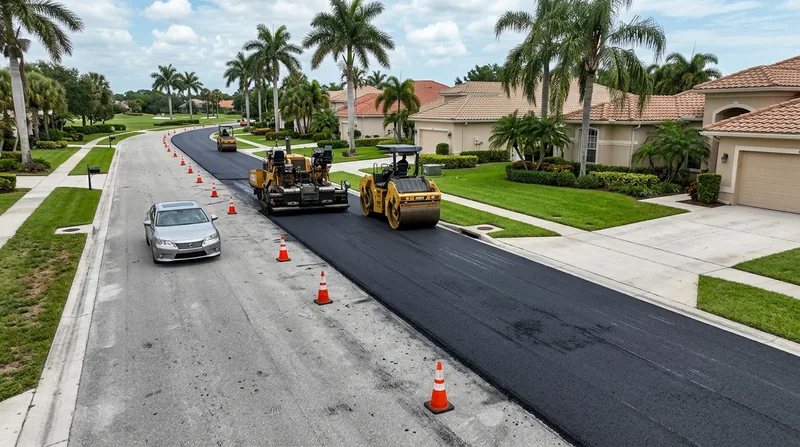




Private Road & HOA Paving in Port St. Lucie covers the linear footage and shared infrastructure that individual driveways cannot: the private lanes threading through Tradition, Torino, PGA Village, and the dozens of master-planned communities across the Treasure Coast; the townhome complexes and apartment drives in Fort Pierce and Stuart; the gated-community streets in Jensen Beach and Palm City; and the private roads that connect clusters of homes west of the turnpike toward Okeechobee and Indiantown. These surfaces carry heavy foot and vehicle traffic, sit exposed to the same relentless Florida sun and summer storm runoff that ages residential asphalt fast, and require a single professional contract with board-ready documentation, phased scheduling that respects resident access, and reserve-study-friendly pricing that spreads the cost over time. Most driveway paving outfits cannot staff the crews and equipment for this work. We do.
Port St. Lucie was platted as a vast quarter-acre-lot grid in the 1960s and 70s, then filled in with 1980s and 1990s ranch homes, followed by the planned communities and golf neighborhoods of the past two decades. The ground is fine sand over a high water table, with muck pockets and coquina, so road bases are built from compacted limerock or crushed concrete. More than 50 inches of rain arrive in summer thunderstorms and hurricanes like Frances, Jeanne, and Milton that flood swales and undercut drive edges. The relentless sun and salt air oxidize asphalt fast, and there is no freeze to crack it, so the enemies are water, heat, and roots. Private roads and HOA streets age the same way as driveways, but they carry more traffic, sit in common ownership, and require a formal process to repair or replace.
Why Private Road and HOA Paving Matters in Port St. Lucie
A private road or HOA street is a shared asset with a finite lifespan. Unlike a residential driveway, which one homeowner can repair or replace on their own schedule, a community street or lane sits under the governance of an HOA board, carries liability exposure, and requires coordination with dozens of residents, a property management company, and a municipality. Water and heat damage compound over time. Alligator cracking spreads. Base failure accelerates. What starts as a repair budget item becomes a crisis that forces an emergency special assessment or a full-depth replacement at three times the cost.
- Early-stage resurfacing and overlay catch deterioration before the base fails and keeps costs predictable.
- A professional paving contractor measures the road, documents the condition, and delivers a written estimate with tonnage and thickness specifications that the board can present to residents and lenders.
- Phased work spreads the cost over multiple years, protecting the reserve fund and avoiding a large special assessment in a single year.
- Proper base repair and drainage prevent water from undermining the edges and swales, which is the dominant failure mode in Port St. Lucie and the Treasure Coast.
- A single contract with a local crew eliminates the risk of piecemeal repairs by different vendors that do not coordinate on base preparation or thickness.
Coordinated, professional paving is the only way to protect a shared asset and the homeowners who rely on it.
Key info: Port St. Lucie and the surrounding municipalities require permits for driveway aprons, culvert work, curb cuts, and impervious-surface changes. HOA architectural standards frequently govern driveway material and extension in master-planned communities like Tradition and PGA Village. We help you navigate local permitting and verify HOA requirements before work begins. Verify permit and HOA rules with your local building department and your community board.
For more on the repair-versus-replacement decision, see our guide to asphalt resurfacing and overlay.
How Private Road and HOA Paving Works in Port St. Lucie
Our process begins with a site visit and a detailed measurement of the entire road or lane, including width, length, slope, and visible condition. We photograph alligator cracking, edge failures, base washout, and drainage problems. We deliver a written estimate that specifies the tonnage of asphalt, the depth of placement, and the base preparation required. The board reviews the estimate, presents it to residents, and makes a decision. We then schedule the work in phases that minimize disruption to resident access and parking, coordinate with the property management company and any utility locates, and complete the job with a compacted, properly crowned surface ready for traffic within 24 to 48 hours.
- We measure the entire road on site and deliver a written estimate with tonnage and thickness specifications for board review.
- We verify local permitting requirements and HOA architectural standards before quoting the job.
- We schedule work in phases that keep resident access open and fit the community's budget and reserve-study timeline.
- We prepare the base by removing failed asphalt, recompacting the subgrade, and adding limerock or crushed concrete where drainage or stability is poor.
- We place asphalt in proper lifts, proof-roll the surface, and compact it to specification so it holds under traffic and resists water infiltration.
- We coordinate with the municipality and the HOA board on permitting, utility locates, and final inspection.
The result is a durable, professionally documented road that protects the community's asset and satisfies lender and insurance requirements.
Real example: A townhome complex in Torino with 12 units and a 150-foot private drive had alligator cracking across 35 percent of the surface and edge failure where the drive met the swale. The base was failing from water infiltration. We removed the failed asphalt, rebuilt the base with compacted limerock, placed 2 inches of new asphalt, and proper-crowned the surface for drainage. The job cost less than a full-depth replacement, extended the road's life by 10 to 12 years, and the board spread the cost over two budget years.
See our work on asphalt driveway repair for the same principles applied to residential driveways.
| Approach | Description | Best for |
|---|---|---|
| Resurfacing and Overlay | Remove the top 1 to 2 inches of failed asphalt, recompact the remaining base, and place new asphalt over it. | Roads with surface cracking and rutting but a solid, well-draining base underneath. |
| Full-Depth Replacement | Remove all failed asphalt and the damaged base, rebuild the base from the subgrade up, and place new asphalt to specification. | Roads with extensive alligator cracking, base failure, or drainage problems that overlay cannot fix. |
| Pothole and Spot Patching | Clean and compact the damaged area, fill with hot-mix asphalt, and compact flush with the surrounding surface. | Isolated failures on otherwise sound roads, or temporary repairs while planning a larger project. |
| Milling and Overlay | Mill off the top 1 to 2 inches of asphalt with a grinding machine, removing all loose material and creating a clean bonding surface for new asphalt. | Roads with surface oxidation and minor cracking where the base is sound but the top layer needs replacement. |
Private Road and HOA Paving Cost in Port St. Lucie: What to Expect
Cost for private road and HOA paving depends on the length and width of the road, the depth of asphalt and base repair required, and whether the work is an overlay or a full-depth replacement. A typical private lane or HOA street in Port St. Lucie runs 100 to 300 linear feet and 18 to 24 feet wide. Overlay work on a sound base starts at around $15,000 to $25,000 for a 100-foot lane. Full-depth replacement on a damaged base runs $30,000 to $50,000 or more depending on base depth and drainage work required. A property manager or HOA board should always get 2 to 3 written estimates with tonnage and thickness specifications before committing to a project.
Several factors move the cost up or down. A road with poor drainage or a high water table requires more base preparation and thicker limerock or crushed concrete, which increases the cost. Extensive tree roots or utilities close to the surface may require hand excavation and careful base work instead of machinery. Access constraints, tight parking, or narrow gates can slow the crew and add labor. A phased schedule across two budget years costs less per phase but takes longer. A full pricing overview and detailed estimate are available on request.
The board should also budget for ongoing maintenance. New asphalt should not be sealed for the first 6 to 12 months while it cures. After that, regular seal coating every 2 to 3 years will extend the life of the road by 5 to 10 years and cost significantly less than resurfacing or replacement. Prompt patching of potholes and cracks prevents small failures from becoming expensive base damage. A well-maintained road lasts 15 to 20 years before resurfacing is needed, and 25 to 30 years before full replacement.
Private Road and HOA Paving Near Me: What Port St. Lucie Homeowners Should Know
Hiring a paving contractor for a private road or HOA project is different from hiring one for a residential driveway. The stakes are higher, the timeline is longer, and the board has a fiduciary duty to the community. A few steps will protect the HOA and the homeowners. First, verify that any contractor you interview is fully insured and willing to provide a certificate of insurance naming the HOA as an additional insured. Second, ask for written estimates with tonnage, asphalt depth, and base specifications on every quote. Third, check references from other HOA projects and commercial work, not just residential driveways. Fourth, verify that the contractor is familiar with local permitting and HOA architectural review in your community. Fifth, ask about the contractor's experience with phased work and reserve-study budgeting.
A local contractor with a local address and local knowledge of Port St. Lucie, Stuart, Fort Pierce, and the surrounding communities is a strong signal of reliability. The historic fraud in paving is the itinerant door-to-door pitch: "we have leftover asphalt from a job nearby." A local shop with a physical address, local insurance, and a track record in the community is the differentiator. You can contact us for a free estimate on your private road or HOA project, and we will deliver a written proposal with all specifications the board needs to make an informed decision.
Private Road & HOA Paving in Port St. Lucie: Pricing Guide
| Service | Price | Details |
|---|---|---|
| Overlay on sound base (100-150 linear feet) | Starting at $15,000 | Includes removal of failed asphalt, base recompaction, and 1.5 to 2 inches of new asphalt placed and compacted to specification |
| Full-depth replacement (100-150 linear feet) | Starting at $30,000 | Includes removal of all failed asphalt and base, subgrade preparation, new limerock or crushed concrete base, and new asphalt to specification |
| Larger roads, phased work, or complex drainage | On estimate | Site-specific conditions including base depth, drainage requirements, tree roots, utilities, and access constraints require an on-site measurement and written proposal |
| Travel and site visit | Included | No separate charge for travel within Port St. Lucie, Stuart, Fort Pierce, Jensen Beach, Palm City, and surrounding Treasure Coast service areas |
| Written estimate with tonnage and specifications | Free | Board-ready documentation including asphalt tonnage, depth, base specifications, and timeline; response within 24 hours at (772) 348-4123 |
Indicative pricing, the exact cost depends on square footage, finish, and site access. Free personalized estimate within 24h at (772) 348-4123.


